
How to angel invest (even if you have no money)
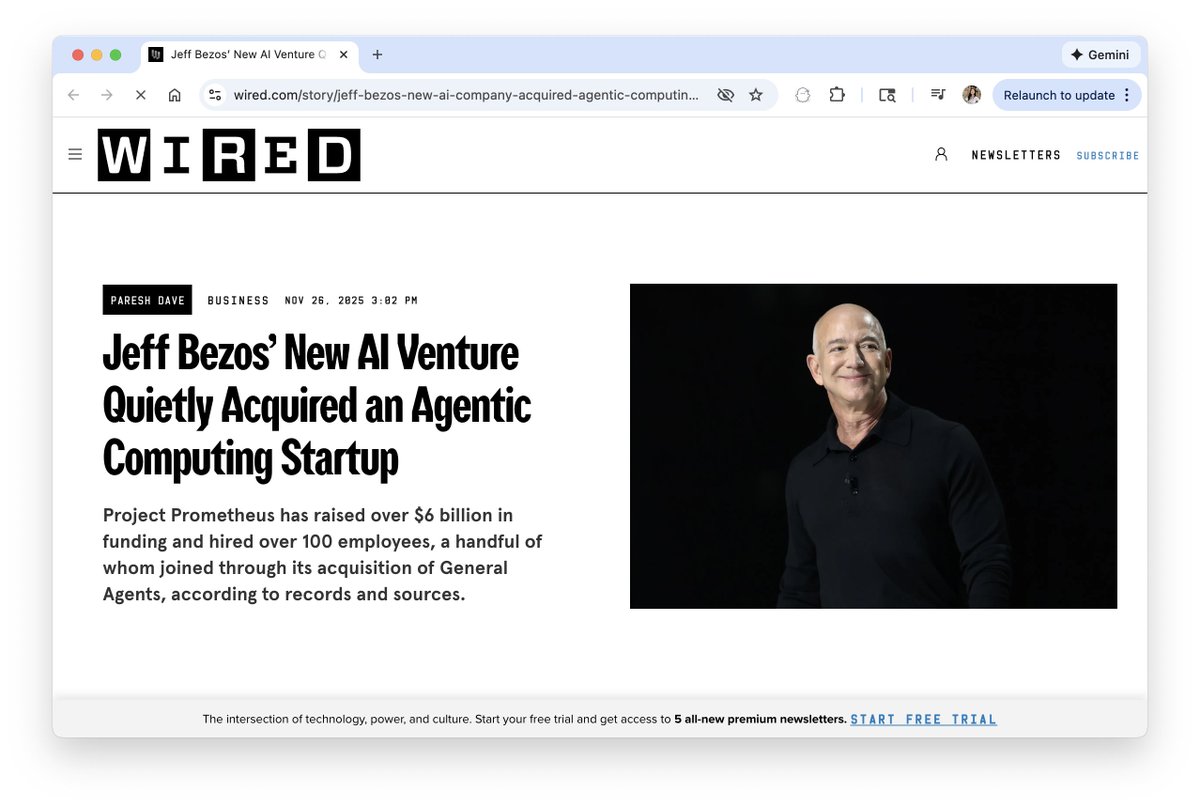
A few months ago, Jeff Bezos acquired the first company I ever angel-invested in.
When I wrote that check, I was 22 years old. I gave $50K into a friend who was building something quietly extraordinary. People often assume that means I must’ve had an insane exit at 19 or family money, but I actually just had access to a system most people don’t know exist.
So if you’re angel-curious, especially early in your career and without spare dollars lying around, here’s how I got started.
There’s a strong misconception that angel investing is about deploying capital.
It is not. Today, we live in a capital-abundant era. In 2025 alone, over $160B was deployed globally into AI and what used to be a $500K pre-seed round is now $2M+. Founders aren’t struggling to find money. They’re struggling to decide which money is actually worth taking.
My first exposure to angels wasn’t as an investor. It was as a founder. When I was building my first startup at MIT, our first investment was a $10K check from James Chen, the CTO of Wonder. We eventually raised from two angels and three funds but it was the angels who actually taught us how to build (also shoutout Cory Levy).
Angel investing is an opportunity for you to support specific teams in the AI (and non-AI) movement beyond the company you work at. It’s a way to scale your own impact. The reality today is that early-stage angels can add more real value than venture funds. This is because operators (like yourself) have a lot of unique value, personal experience, and specific expertise to contribute.
But I have no money?
Today, it is easier than ever to start angel investing, even if you are early in your career or don’t have large amounts of excess personal capital.
Many of my friends and I all started out as angel investors scouting for a VC firm. This is a safe, high-upside way to get started. You invest with a firm’s dollars and get a cut of the return if the company you invest in IPOs or gets acquired. Most VC firms have scout programs, like BCV, a16z, Sequoia, Index, KP, etc. And the reality is that most VC firms, even if they don’t have an official program, would be open to having scouts.
How to get into a scout program
These programs are largely informal, and the entry process is generally getting to know some of the partners. From my experience, you only need one partner to vouch for you and take you under their wing.
However, each fund has pretty different angel investing structures that you should think about. Certain companies give full autonomy, basically ‘here’s $X per year that you can allocate to whatever companies you’d like’. Other funds work you like an unpaid associate where you only have the power to bring open deals back to the partners who make all of the decisions. Personally, I prefer the former, and have an agreement like that with BCV.

After figuring out your source of capital, your next objective is to learn how to invest wisely.
How to become a GOOD angel investor.
There are three main pillars for how I like to approach angel investing. Spoiler, I have no performative thesis.

Pillar #1: Understand your value
Angel investing is not about money, it is about value.
As an angel investor, your contribution is not the dollar amount you invest - it is the connections or knowledge that you bring to the table. Good founders are already oversubscribed.
Start by asking yourself this: Where would my contributions be most valuable?? This will help you
filter what companies/domains you talk to
get your check into the round
grow your own skills
There are many flavors to adding value. For example, if you’re an absolute devil at GTM, then help the team with GTM. If you work at OpenAI, help a team get early access to models or features.
If you do not think in this value-adding way, you will not get allocation and the only founders who will take your money are the ones you shouldn’t be backing.
Pillar #2: Pick a partner you trust
Your learning rate as an angel is determined entirely by who you’re allowed to be wrong next to.
Eons more important that what firm you scout for, is who you scout for. Someone who’s own investment methodology you trust who you can call and say,
‘hey, here’s what I’m thinking about this RL company that I swear is different from all of the other RL companies, what do you think?’
You will learn more and make increasingly better decisions this way. At the end of the day, people care about what investments you made, not what firm you scouted for. Don’t be vain.
Pillar #3: Best Friends or Michael Jordan
There are only two kinds of founders you should angel invest in: your best friends or Michael Jordan. Anything else should be a no.
Either you know the founders so intimately that you can underwrite their judgment, resilience, and integrity through inevitable failure, or they are so objectively exceptional that their talent is undeniable even from the outside.
As an angel, your bar for investment should be much higher than a standard VC. This is because VCs can afford things like portfolio dilution and long time horizons. They take many shots. You do not.
A concluding note
Speaking of adding value, here are a few companies I’ve invested in recently both personally and as a scout. Each one is tackling an ambitious, non-obvious problem and hiring. If you’re looking for something new, or just want to work on something that actually matters, I’d encourage you to check them out:
Applied Compute: is building specific intelligence, custom models and in-house agent workforces trained on a company’s proprietary knowledge. The team was started by three brilliant ex-OpenAI researchers. Learn more [here].
General Agents (Now Project Prometheus): is an AI initiative led by Jeff Bezos focused on "physical AI" for manufacturing and engineering. Learn more and reach out [here].
General Intelligence Company: is building the infrastructure for the one-person billion-dollar company. They just announced their $8.7 Million seed round and are absolutely crushing it. Learn more and reach out [here].